


OpenAI AI Phone Could Redefine the Future of Smart Devices

An “OpenAI phone” may seem like one more internet rumor, but if you dig deeper, you can see that the company has already moved far beyond just talking about their ambitions for a better future. For several years now, OpenAI has been developing tools that are really used by people, and ChatGPT has become an inseparable part of the everyday routine, whether it’s writing emails or finding solutions to complicated questions. Now, however, the company is thinking about the future, and, apparently, about hardware rather than software.
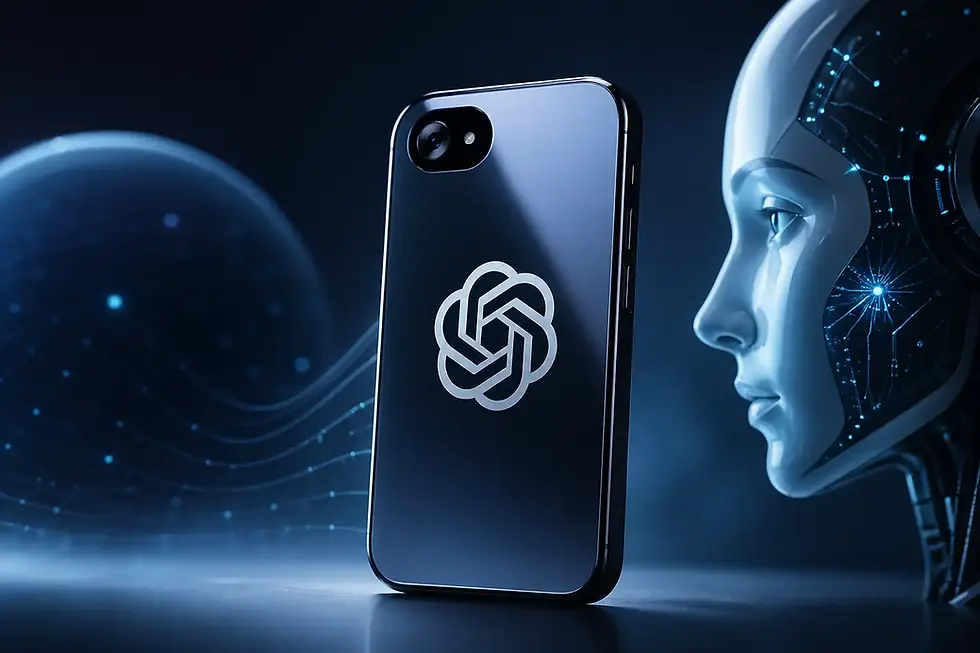
OpenAI Phone Leak
The most recent claim made by Ming-Chi Kuo, a renowned analyst of Apple’s supply chain, proposes that there is some secret development going on inside OpenAI of an AI-first device. Based on his posts, OpenAI is allegedly working with semiconductor companies such as Qualcomm and MediaTek to build dedicated processors.
What is even more intriguing is that the Chinese electronics manufacturer, Luxshare, might be the one to design and manufacture the device.
Assuming these claims to be true, the mass production process of the product can start by 2028, which is not that far off considering the development process of hardware products.
Is OpenAI Really Building a Smartphone?
Now comes the part where it gets slightly complex.
Previous reports suggested that Sam Altman has teamed up with the world-renowned designer of Apple, Jony Ive, to work on a revolutionary new kind of AI product. Not just another smart phone, but something completely different.
As per Sam Altman himself, the product will be a "third core device," which would be distinct from computers and phones.
This brings us to an intriguing conundrum. While the leaks hint towards a product similar to a phone, the product concept suggests otherwise. This would give rise to a device that could be termed an amalgamation of all the three.
Why OpenAI Wants to Build Its Own Device
The rationale behind this is quite logical, indeed.
In modern times, smartphones are still among our essential devices, continuously collecting information about us – our location, behavior, communication patterns, preferences, etc. And such information for a company focused on creating AI is highly useful.
To be able to advance further and create not just conversational assistants, but intelligent and proactive ones, OpenAI would need access to all that context. The best way to get there is to control both hardware and software.
Or, in other words, AI can benefit greatly from being able to understand the user's environment in real time which is easily achieved through a smartphone.
It might sound somewhat obvious, but there is also the economic motive involved: having its own hardware allows a company to:
Incorporate subscriptions into the device itself
Establish a closed ecosystem
Be less dependent on competing platforms
All that was the key to success for Apple and other tech giants.
Can OpenAI Compete in the Smartphone Market?
Joining the fray of smartphones will certainly pose a significant hurdle.
There are well-established players such as Samsung and Apple in the market with highly embedded operating systems, large customer followings, and vast experience in building hardware.
But the truth is that it might not be OpenAI’s intention to play the competition game in the usual manner.
As opposed to making “yet another smartphone,” the company could think about manufacturing something that feels smarter altogether; something capable of predicting your intentions and acting accordingly.
After all, the smartphone business has become rather predictable. It has become time for something disruptive to happen.
What Comes After Smartphones?
But ultimately, this is much more than just a phone from OpenAI.
This represents a bigger query for the tech world: What will be the next personal computing device?
The partnership between Sam Altman and Jony Ive indicates that OpenAI is not merely looking at building another computer screen or app-based interface. Instead, they aim to construct a gadget that does not merely incorporate AI technology; rather, it will have AI technology as its foundation.
Currently, it’s too soon to verify any of it.
All of the rumors are plausible, the partnerships are logical, and the concept is ambitious but none of this has been made official yet. Rather, what may well be occurring is that OpenAI is testing the waters, experimenting, and defining the shape of tomorrow’s personal tech revolution.
Be it a phone, a companion piece, or something altogether different, there is no doubt that the next generation of technology will not just be more intelligent applications instead, they will be more intelligent devices.
And when it comes to OpenAI getting it right, our relationship with technology may never be the same.


Comments